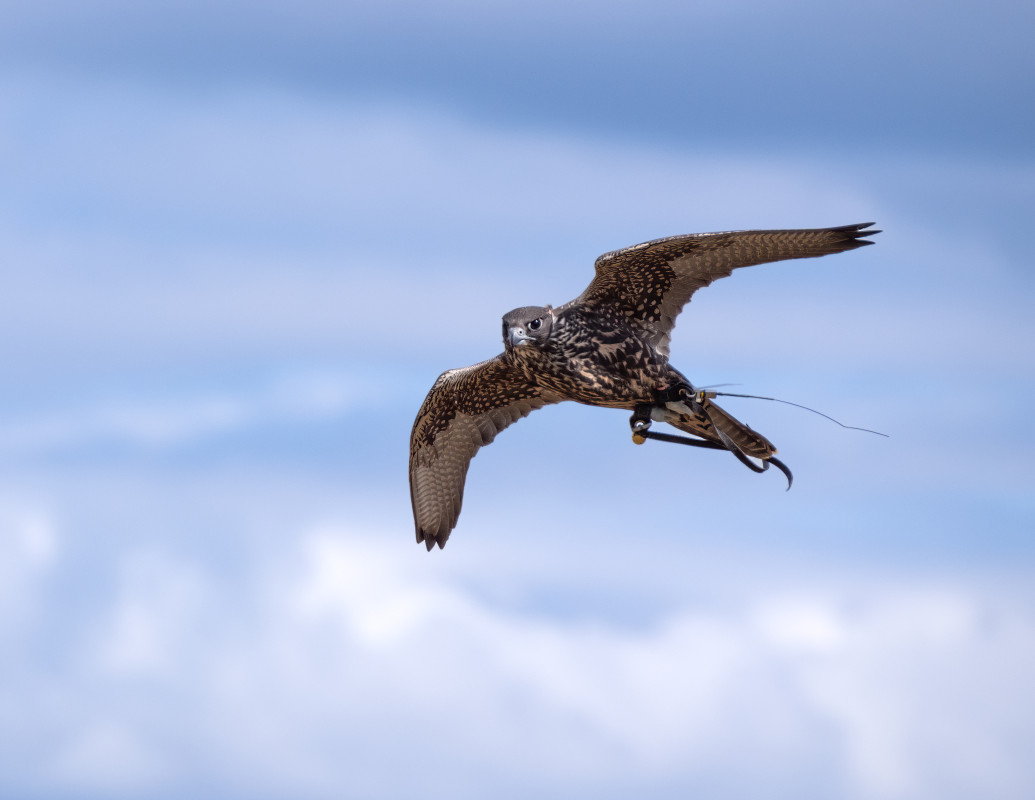
This short article describes the evolution of the International Bird of Prey Welfare Standards and their relevance to modern falconers. Raptor Awards CIC maintains the standards on behalf of the International Falconry Community.
Introduction:
Raptor Awards CIC exists to improve bird of prey welfare through education, training and assessment, and we achieve this by providing certificated learning/education opportunities based on the International Standards for Bird of Prey Welfare ('the standards'). At present we are the only body offering courses properly aligned to these important bird of prey welfare standards.
How do we achieve this?
To ensure that there is a welfare benefit to the work we do, candidates who wish to be awarded a Raptor Awards Certificate must reach a certain level of knowledge and understanding about birds of prey, and must also be capable of demonstrating their practical handling skills. To achieve certification they are assessed by specially trained assessors who are all falconers of long experience. The specialist assessors are issued with a set of written 'Standards' against which candidates are assessed.
What is meant by the term 'Standards'?
In the UK and across the rest of Europe, Governments have funded the development of 'National Standards' for most occupations. To receive a certificate for any vocational, work-related activity in the UK and Europe candidates must demonstrate to a properly qualified assessor that they are 'competent' to perform the stated actions, and that the have the correct underpinning knowledge and understanding of what they are being asked to do.
For example, here is a short extract from the National Standards for NVQ level 2 for plumbers who install and commission domestic heating systems
“Knowledge and understanding: (the candidate must 'know' and understand' – ed)
1. the applications, advantages and limitations of different plumbing
and heating systems
2. the applications, advantages and limitations of appliances,
components and accessories in relation to the working environment
3. the appropriate industry standards and regulations relevant to the
commissioning of plumbing and heating systems
4. how to verify that job information and documentation……. Etc “
Further documentation in the written 'standard' describes things like the assessment processes and the breadth of knowledge required.
In the UK, Lantra, the Land-based Sector Skills Council, was the Standard-Setting body with responsibility for the 'Land-Based Sector' including animal care qualifications. In the past they offered the 'Beginning Falconry Award' for new bird of prey keepers and falconers.
Who developed the standards?
The Raptor Awards began when Julie Murphy realised that there were no formally certificated courses for new entrants wishing to keep birds of prey. Julie worked alongisde Derek Hartshorne (previous administrator of the Raptor Awards) to organise and pull together those that contributed to the Raptor Award standards.
More than 30 well-known falconers have contributed in many ways to the development of the Original Standards. However, Raptor Awards would specifically like to express their gratitude to the following individuals whose self-less generosity and support over many years made the development of the Standards possible :
Jemima Parry-Jones MBE
Dr Nick Fox OBE, BSc, CEd, PhD
Nick Kester
Dr Mike Nicholls PhD, MSc, FIBiol, FHEA.
Dr Neil Forbes BVetMed, Dip ECZM(avian), FRCVS
Dr Karl Jennings. BVSc MRCVS
Following the approval of the Phase 2 Standards Raptor Awards launched modules C1 to C8 which supported two Awards, namely 'Keeping birds of prey', and Training birds of prey'. These are:
A further module C9 'Flying unrestrained birds of prey' joined the basic suite of standards from April 2020.
Updated Standards – Phase 3 (2025)
Following the introduction of the new Phase 3 (2025) Raptor Award Standards, developed in line with modern practices and guided by the new Stewards of the Raptor Awards, we are pleased to acknowledge the invaluable input of specialists and representatives from across the raptor field:
Jemima Parry-Jones MBE
Dr Nick Fox OBE, BSc, CEd, PhD
Charlie Heap, Director, National Centre for Birds of Prey
Mark Upton Chairman of the Hawk Board and President of the International Association for Falconry and Conservation of Birds of Prey
David Rampling, Senior Falconry Practitioner and Assessor
David Hughes, Raptor Specialist
Dr Tom Dutton BVetMed (Hons), CertAVP(ZooMed), DipECZM(avian), MRCVS, Specialist Avian Veterinarian
Standards Review Process
Raptor Awards undertakes regular reviews to ensure our standards reflect the latest research, knowledge, and best practice in raptor welfare, training, and management. We remain committed to maintaining the highest level of quality and relevance across all courses and certifications.
Standards for bird of prey professionals and commercial falconers
Representations from various organisations and individuals who use birds of prey in a commercial / professional capacity have been involved with the development of advanced awards for more experienced falconers.
Working with industry groups drawn from the commercial bird of prey world, Raptor Awards CIC continues to develop national standards for higher level and specialist skills.
Interested in helping improve bird of prey welfare?
If you are passionate about bird of prey welfare and believe that education and training is one of the best ways of improving welfare standards then you may wish to consider putting yourself forward as a working group expert. If you have a specific area of expertise, and are able to devote some time to the cause we would be delighted to hear from you. Please note that these positions are not remunerated.
Raptor Awards CIC is recognised as a not-for-profit organisation. Read more about not-for-profit organisations here:
https://www.gov.uk/set-up-a-social-enterprise